
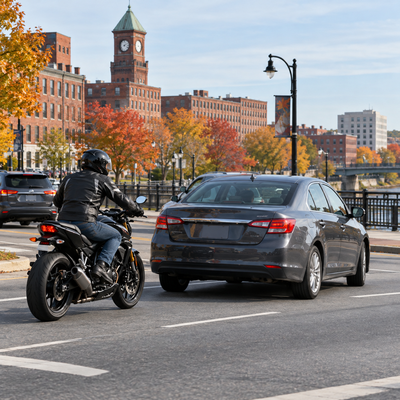
Lane-change motorcycle accidents in Manchester, New Hampshire, frequently involve drivers who overlook motorcycles in blind spots, misjudge their speed or distance, or move into occupied lanes without adequate warning. These collisions can cause serious injuries because motorcycles offer less physical protection than passenger vehicles.
Under New Hampshire RSA 265:45, drivers must ensure that moving right or left on a roadway can be completed with reasonable safety and must provide appropriate signals. When a driver makes an unsafe lane change and injures a motorcyclist, the injured rider may have grounds to pursue compensation for medical expenses, lost income, pain and suffering, and other legally recognized damages.
If you were injured in a lane-change motorcycle accident, identifying who caused the collision and preserving evidence can help protect your right to seek compensation.
Tenn And Tenn, PA represents injured riders in Manchester and throughout New Hampshire. The firm's New Hampshire motorcycle accident lawyers help motorcyclists investigate collisions, assess liability, and understand the options available for pursuing injury claims.








Why Lane Changes Are Dangerous for Manchester Motorcyclists
Motorcycles have smaller profiles than passenger cars, SUVs, and commercial trucks, making them more difficult for surrounding drivers to notice. A motorcycle may be visible in one moment and partially concealed within another vehicle's blind spot in the next.
Lane changes are especially hazardous when drivers fail to assess surrounding traffic before moving laterally.
Manchester has several multilane roadways where drivers regularly merge, change lanes, and adjust their speeds, including Interstate 293, Interstate 93, and South Willow Street. Commercial corridors near South River Road in neighboring Bedford also require drivers to remain attentive to surrounding vehicles.
Several factors make lane-change collisions particularly dangerous for motorcyclists:
- Limited visibility: Motorcycles can be harder to identify in side mirrors and surrounding traffic.
- Reduced reaction time: Sudden lane changes may leave riders with insufficient time to brake or maneuver.
- Limited physical protection: Motorcycles generally lack the protective passenger compartments, seat belts, and airbags found in enclosed vehicles.
- Loss of balance: Even a minor sideswipe may destabilize a motorcycle and cause the rider to fall.
- Secondary impacts: A rider may strike another vehicle, roadside barrier, or roadway surface after the initial collision.
Understanding these risks helps explain why unsafe lane changes can result in significant injuries, even when the initial contact between vehicles appears minor.

James J. Tenn, Jr.
Attorney

Mary Elizabeth Tenn
Attorney

John J. Tenn
Attorney
5 Common Causes of Lane-Change Motorcycle Accidents
Lane-change motorcycle accidents can result from several forms of negligent driving. Identifying the specific cause is essential when determining responsibility and evaluating an injury claim.
1. Failing to Check Blind Spots
Failing to check blind spots is a common contributing factor in motorcycle lane-change collisions.
Vehicle mirrors provide only a partial view of surrounding traffic. A motorcycle traveling beside a passenger vehicle may remain outside the driver's direct line of sight.
Before changing lanes, drivers should check their mirrors and surrounding traffic to determine whether another vehicle occupies the intended lane.
Consider a hypothetical situation involving a motorcyclist traveling along Interstate 293 in Manchester.
A passenger vehicle approaches in the adjacent lane. The driver checks a side mirror but fails to notice the motorcycle positioned near the rear quarter of the vehicle. When the driver begins moving laterally, the vehicle enters the motorcycle's lane.
The resulting contact could force the rider toward another vehicle or roadside barrier.
This example illustrates how a driver who fails to check surrounding traffic may cause a serious collision.
Key takeaway: A motorcycle being positioned in a blind spot does not automatically excuse a driver's failure to make a safe lane change.
Millions in Verdicts & Settlements
The attorneys at Tenn And Tenn are ready to help you solve your legal problems and obtain results.
$9,000,000
Pedestrian Accident
$2,225,000
Motorcycle Collision
$2,224,000
CarAccident
2. Changing Lanes Without Proper Signaling
Turn signals communicate a driver's intentions to nearby motorists.
When a driver changes lanes without signaling, surrounding riders may have limited opportunity to anticipate the movement and respond.
New Hampshire RSA 265:45 requires drivers to make lateral roadway movements with reasonable safety and to provide appropriate signals.
You can review the applicable statute through the New Hampshire General Court.
A driver who signals a lane change must still evaluate whether the intended lane is occupied.
Using a turn signal does not automatically establish the right to move into another vehicle's path.
For an injured motorcyclist, evidence showing whether a driver signaled before changing lanes may help establish how the collision occurred.
3. Misjudging Motorcycle Speed and Distance
Drivers may have difficulty accurately estimating the speed and distance of approaching motorcycles because motorcycles present a smaller visual profile than larger vehicles.
This can create dangerous situations when drivers attempt to merge or change lanes ahead of approaching riders.
For example, a driver entering Interstate 93 may notice a motorcycle traveling in the adjacent lane but incorrectly estimate the available space.
The driver begins merging before sufficient clearance exists, placing the motorcyclist at risk.
This type of collision can occur even when the motorcycle is traveling within the posted speed limit.
Relevant factors may include:
- The motorcycle's speed and position before the collision.
- The distance between vehicles when the lane change began.
- Traffic conditions and available visibility.
- Whether the driver had sufficient time to identify the motorcycle.
- Whether either operator had a reasonable opportunity to avoid the collision.
These details can help determine whether a driver failed to exercise reasonable care.
4. Distracted Driving Before a Lane Change
Distracted driving can prevent motorists from recognizing motorcycles traveling nearby.
Drivers who look at mobile phones, adjust navigation systems, or divert their attention toward passengers may miss changes in surrounding traffic.
Lane changes require drivers to monitor several conditions simultaneously, including vehicle positions, traffic speed, roadway markings, and available space.
Consider a driver traveling along South Willow Street who looks at a navigation screen before moving into another lane.
If a motorcyclist already occupies that lane, the driver's momentary distraction may contribute to a collision.
Evidence that may help establish distracted driving includes:
- Witness observations.
- Available dashboard camera footage.
- Nearby surveillance recordings.
- Driver statements.
- Relevant electronic records obtained through appropriate legal procedures.
An investigation can help determine whether distraction contributed to the unsafe movement.
5. Sudden Lane Changes in Heavy Traffic
Congested roadways can create situations where drivers attempt abrupt lane changes to reach exits, intersections, or turning lanes.
Motorcyclists may have limited time to react when another vehicle unexpectedly enters their lane.
Common situations include:
- A driver crossing multiple lanes to reach an approaching highway exit.
- A vehicle entering an occupied lane without adequate clearance.
- A motorist accelerating while changing lanes.
- A driver moving into a motorcycle's lane while passing another vehicle.
- Two vehicles attempting to enter the same lane simultaneously.
- A motorist making a last-minute lane change near an intersection.
Determining responsibility requires examining the positions and movements of the vehicles involved.
Where Lane-Change Motorcycle Accidents Can Occur in Manchester, NH
Lane-change motorcycle accidents can occur on any roadway with multiple travel lanes. Certain traffic environments create additional opportunities for vehicles to move into conflicting positions.
Interstate 293 and Interstate 93
Interstate 293 and Interstate 93 include entrance ramps, exits, and interchanges where motorists must monitor vehicles traveling at different speeds.
A rider maintaining a consistent lane position may encounter a driver attempting to merge into the same lane.
At highway speeds, a sudden lane change can reduce the time available for evasive action and increase the potential severity of a collision.
South Willow Street
South Willow Street includes commercial businesses, traffic signals, intersections, and access points where drivers may change lanes while approaching turns or entrances.
Motorists concentrating on a destination or an upcoming intersection may overlook a motorcycle traveling nearby.
Drivers must remain attentive to surrounding traffic when making these movements.
Manchester Intersections and Turning Lanes
Intersections with multiple travel lanes and dedicated turning lanes can create conflicts between vehicles.
A driver preparing for a turn may move across lanes without recognizing a motorcycle occupying the intended path.
These roadway descriptions identify possible collision environments. They do not establish that any particular Manchester roadway or intersection has a higher documented motorcycle accident rate.
Who Is Responsible for a Lane-Change Motorcycle Accident?
Responsibility for a lane-change motorcycle accident generally depends on whether a driver failed to exercise reasonable care and whether that failure caused the rider's injuries.
New Hampshire law requires drivers to make lateral roadway movements safely.
A driver may be found negligent if the evidence shows that the driver:
- Changed lanes without checking for nearby vehicles.
- Failed to provide an appropriate signal.
- Entered a lane already occupied by a motorcycle.
- Misjudged the distance available for a safe lane change.
- Made a sudden movement without adequate clearance.
- Failed to observe surrounding traffic because of distraction.
Liability depends on the circumstances of the collision.
The fact that a passenger vehicle struck a motorcycle does not automatically establish that its driver was responsible.
Investigators must evaluate the conduct of everyone involved, including whether the motorcyclist contributed to the collision.
An attorney can help examine the available evidence and determine whether another party may be legally responsible.
What Evidence Helps Prove Fault in a Motorcycle Accident?
Evidence plays a central role in reconstructing lane-change collisions.
Useful evidence may include:
- Police accident reports: Documentation of vehicle positions, statements, observations, and other reported facts.
- Witness statements: Accounts describing lane movements, signaling, traffic conditions, and the sequence of events.
- Dashboard camera footage: Recordings that may show how and when the lane change occurred.
- Surveillance footage: Video from nearby businesses or properties that may capture relevant portions of the collision.
- Vehicle damage: Damage patterns that may help establish points of contact.
- Accident scene photographs: Images of roadway markings, debris, vehicle positions, and surrounding conditions.
- Electronic evidence: Relevant records that may help establish a driver's actions.
- Accident reconstruction findings: Technical analysis that may assist in understanding how the collision occurred.
Witness accounts can be particularly useful when drivers disagree about their movements before a crash.
For additional information, read The Role of Eyewitness Testimony in Motorcycle Accident Cases.
Preserving evidence early can make a meaningful difference. Surveillance footage may be overwritten, witnesses may become difficult to locate, and roadway conditions may change.
What If the Motorcyclist Is Partially Responsible?
New Hampshire follows a modified comparative fault system under RSA 507:7-d.
This law allows an injured person to recover damages when their percentage of fault is not greater than the fault of the defendant or the defendants in the aggregate, subject to the statute's requirements.
In a typical two-party negligence case, this generally means an injured rider may recover compensation when the rider's fault is 50% or less.
The rider's recoverable damages are reduced according to the percentage of fault assigned.
Example of Comparative Fault in a Motorcycle Accident
Consider a hypothetical collision involving a driver who makes an unsafe lane change while a motorcyclist is traveling slightly above the posted speed limit.
After evaluating the evidence, the motorcyclist is assigned 20% of the responsibility.
If the total damages are assessed at $100,000, the calculation would be:
- Total damages: $100,000
- Motorcyclist's fault: 20%
- Reduction in damages: $20,000
- Remaining recoverable damages: $80,000
If the motorcyclist is found more than 50% responsible in a two-party case, recovery would generally be barred.
The allocation of fault can become more complicated when multiple responsible parties are involved.
Insurance companies may argue that a rider was speeding, positioned improperly, or operating the motorcycle in a way that contributed to the crash.
These allegations should be evaluated using available evidence rather than accepted without investigation.
For additional guidance, a New Hampshire personal injury lawyer can explain how comparative fault may affect a claim.
The full comparative fault statute is available at https://gc.nh.gov/rsa/html/lii/507/507-7-d.htm.
Common Injuries in Lane-Change Motorcycle Accidents
Lane-change collisions can cause severe injuries because motorcyclists are directly exposed to surrounding vehicles and roadway surfaces.
Even when a collision begins as a sideswipe, the impact may cause the rider to lose control, fall, or strike another object.
Common injuries include:
- Traumatic brain injuries: Head trauma that may cause cognitive, physical, or neurological complications.
- Broken bones: Fractures affecting the arms, legs, shoulders, pelvis, or other areas.
- Spinal cord injuries: Damage that may affect mobility, sensation, or other bodily functions.
- Road rash: Skin and tissue injuries caused by contact with pavement.
- Shoulder injuries: Dislocations, fractures, and soft tissue damage caused by direct impact.
- Knee and joint injuries: Damage that may limit mobility and require rehabilitation.
- Internal injuries: Trauma involving internal organs or bleeding that requires medical evaluation.
Some injuries require surgery, physical therapy, ongoing medical care, or extended time away from employment.
Medical records help establish the nature of the injuries, the treatment provided, and the effects on the rider's daily life.
In cases involving permanent impairment or long-term medical needs, additional evidence may be necessary to evaluate future damages.
Injured riders facing lasting physical limitations can learn more through the firm's New Hampshire catastrophic injury attorneys page.
What Should You Do After a Lane-Change Motorcycle Accident?
Your actions after a motorcycle collision can affect your physical recovery and the evidence available to support a personal injury claim.
Your health should remain the first priority.
Seek Medical Attention
Obtain medical evaluation promptly after a motorcycle accident.
Some injuries may produce symptoms that are not immediately apparent.
A medical examination can help identify injuries requiring treatment and create documentation of your condition following the crash.
Report the Accident to Law Enforcement
Contact law enforcement when required and provide an accurate description of the collision.
Explain what you observed without speculating about facts that you could not personally verify.
A police report may provide useful information for subsequent investigations and insurance claims.
Document the Accident Scene
When physically able and when conditions are safe, collect photographs showing:
- The motorcycle and other involved vehicles.
- Visible vehicle damage.
- Lane markings and roadway conditions.
- Traffic signals and nearby intersections.
- Debris, skid marks, or other relevant physical evidence.
- The surrounding area where the collision occurred.
Photographs taken shortly after the collision may help preserve details that subsequently change.
Collect Witness Information
If someone observed the accident, obtain the person's name and contact information when possible.
Witness statements may help establish whether the other driver signaled, changed lanes abruptly, or entered an occupied lane.
Preserve Damaged Equipment
Keep damaged motorcycle components, helmets, jackets, gloves, and other riding equipment when possible.
These items may provide useful information about the collision and the resulting injuries.
Maintain Medical and Financial Records
Keep organized copies of documents related to the accident, including:
- Medical bills and treatment records.
- Prescription expenses.
- Physical therapy documentation.
- Evidence of missed employment.
- Repair estimates and motorcycle damage assessments.
- Relevant insurance communications.
These records may help establish the financial consequences of the collision.
Discuss Your Legal Options
A motorcycle accident attorney can evaluate available evidence, assess potential liability, and explain the applicable legal process.
The attorney may also help identify evidence that should be preserved before it becomes unavailable.
Your medical recovery comes first. Evidence collection should never delay emergency care or place you in additional danger.
What Compensation May Be Available After a Lane-Change Motorcycle Accident?
An injured motorcyclist may be entitled to compensation when another party's negligence causes legally recognized damages.
The specific compensation available depends on the injuries, evidence, liability, and applicable law.
Potential damages may include:
- Medical expenses: Emergency care, hospitalization, surgery, medications, and other necessary treatment.
- Future medical costs: Reasonably supported expenses for continuing treatment, rehabilitation, or related care.
- Lost wages: Income lost when injuries prevent a rider from working.
- Reduced earning capacity: Financial losses associated with diminished long-term ability to earn income.
- Pain and suffering: Compensation for legally recognized physical pain and related noneconomic harm.
- Permanent impairment: Damages associated with lasting limitations or disability.
- Motorcycle property damage: Repair or replacement expenses when recoverable under the circumstances.
The value of an injury claim depends on the evidence supporting the losses.
A collision involving permanent injuries may require medical opinions, employment records, financial projections, and other documentation.
Insurance coverage and fault allocation can also affect the amount ultimately recovered.
An attorney can review these factors and help assess potential compensation based on the circumstances of the accident.
How Long Do Injured Motorcyclists Have to File a Claim in New Hampshire?
Under RSA 508:4, most New Hampshire personal injury lawsuits are subject to a three-year filing deadline.
The three-year period generally begins on the date of the act or omission giving rise to the injury.
The statute includes a discovery provision for certain circumstances in which the injury and its causal relationship to the wrongful act could not reasonably have been discovered earlier.
Other circumstances may involve different deadlines or procedural requirements.
The statutory text is available through the New Hampshire General Court.
It is essential to distinguish between reporting an insurance claim and filing a lawsuit within the applicable legal deadline.
An insurance claim does not necessarily preserve the right to pursue a lawsuit after the statute of limitations expires.
Seeking legal guidance promptly can help identify the applicable deadline and protect relevant evidence.
Frequently Asked Questions About Lane-Change Motorcycle Accidents
Can a Driver Be Liable if the Motorcycle Was in a Blind Spot?
Yes. A motorcycle being in a driver's blind spot does not automatically eliminate the driver's responsibility. Liability depends on whether the driver exercised reasonable care before changing lanes and whether the unsafe movement caused the collision.
Does Using a Turn Signal Eliminate Liability?
No. A driver must ensure that a lane change can be completed safely. Providing a signal does not establish permission to enter an occupied lane or excuse an otherwise unsafe movement.
Can I Recover Compensation if I Was Partially Responsible?
Possibly. New Hampshire's modified comparative fault rules generally permit recovery when the injured rider's fault does not exceed the applicable statutory threshold. Any recoverable damages are reduced in proportion to the rider's assigned fault.
What Happens if the Other Driver Denies Changing Lanes?
Photographs, witness testimony, vehicle damage, available video recordings, and accident reconstruction findings may help establish the sequence of events. The evidence can be evaluated to determine how the collision occurred.
Can I Pursue Compensation if a Lane-Change Accident Caused a Motorcycle to Fall Without Vehicle Contact?
Potentially. Physical contact between vehicles is not always required to establish a negligence claim. A rider may be able to pursue compensation when evidence shows that another driver's negligent conduct caused the crash and resulting injuries.
How Long Does a Motorcycle Accident Claim Take to Resolve?
The duration depends on factors such as injury severity, treatment needs, available evidence, disputes over liability, insurance negotiations, and whether litigation becomes necessary. Some claims resolve through negotiation, while others require additional legal proceedings.
Should I Speak With an Insurance Company After a Motorcycle Accident?
You may have obligations to report the collision and cooperate with your own insurer under the applicable policy. Provide accurate information and review any requests for recorded statements or broad medical authorizations carefully. An attorney can explain your obligations and help you evaluate communications concerning fault or settlement.
Do I Need an Attorney for a Lane-Change Motorcycle Accident Claim?
Legal representation is not mandatory for every claim. An attorney may be particularly helpful when injuries are serious, fault is disputed, several parties are involved, or the insurer challenges the amount of compensation requested.
Speak With a Manchester Motorcycle Accident Attorney
A lane-change motorcycle accident can leave you facing medical expenses, missed employment, physical limitations, and uncertainty about your financial recovery.
Tenn And Tenn, PA represents injured motorcyclists in Manchester, Bedford, Nashua, Concord, Derry, and communities throughout New Hampshire.
Since 1995, the firm has represented New Hampshire clients in personal injury and other legal matters. Attorney John J. Tenn is also a motorcyclist, providing personal familiarity with the riding experience alongside his legal practice.
The firm's attorneys can review the circumstances surrounding your accident, identify potential sources of compensation, and explain your legal options.
If you were injured because another driver made an unsafe lane change, contact Tenn And Tenn, PA to discuss your motorcycle accident claim.
You can also contact the firm online:
Manchester Office:
16 High Street, Suite 3 Manchester, NH 03101
Let our family work for your family.
This article is provided for informational purposes only and does not constitute legal advice. Every motorcycle accident claim depends on its particular circumstances. Consult a qualified attorney about your specific legal situation.


 |

 |