
Cold mornings can change motorcycle safety conditions in New Hampshire by lowering tire pressure, increasing the time tires may need to warm for traction, and allowing dew or frost to remain on shaded pavement, bridges, ramps, and road edges. A road that looks dry near your home may be damp, frosted, or colder a few miles later after an overnight temperature drop.
You can reduce risk by checking tire pressure before you ride, inspecting your tires and controls, leaving more room to brake, and using gradual throttle, steering, and braking inputs. You should give extra attention to shaded roads, bridge decks, ramps, painted markings, metal covers, wet leaves, and other surfaces that may offer less traction when damp or cold.
Cold weather does not decide who is responsible for a motorcycle crash. Fault depends on what each person did, the road and visibility conditions, and the evidence available after the collision. Tenn And Tenn, PA represents injured motorcyclists throughout New Hampshire and helps clients evaluate driver conduct, road conditions, insurance issues, evidence, and comparative fault.
Cold weather can reduce your margin for sudden corrections, but it does not automatically establish fault after a crash. Evidence showing what happened before the collision still matters.








Why Cold Mornings Can Change Motorcycle Handling 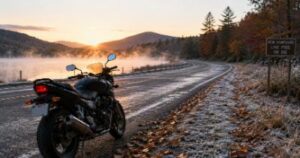
Cold mornings can affect motorcycle handling because both tire pressure and tire performance change with temperature. Cold weather can lower tire pressure, and motorcycle safety guidance recommends checking pressure when the tires are cold and using the motorcycle manufacturer’s recommended settings.
Tires may also need more time to warm during colder rides. During the first part of your ride, use moderate lean angles and gradual braking and acceleration until the tires have had time to reach normal operating conditions.
Check your motorcycle before leaving. Look for unusual tire wear, cuts, cracks, embedded objects, visible damage, or other conditions that may affect safe operation. Confirm that the brakes, lights, signals, mirrors, and controls are working as expected.
For more general riding guidance, visit:
https://www.tennandtenn.com/new-hampshire-motorcycle-safety-tips/
Frost, Dew, and Damp Pavement Can Be Hard to See
Frost, dew, and damp pavement can create hazards that are difficult to identify from a motorcycle. Dew can make pavement wet even when there has been no rain. Frost can form on surfaces when conditions allow surface temperatures to fall below freezing, including times when the reported air temperature is slightly above 32 degrees Fahrenheit.
Bridge decks and overpasses can cool faster than pavement resting on the ground because cold air can circulate above and below the structure. Shaded areas may also remain colder after sunrise. That means a bridge, ramp, or shaded curve may be slick even when the pavement before it appears dry.
If you are riding from Manchester toward Concord or traveling on another New Hampshire route early in the morning, do not assume that one dry section represents the entire trip. Watch for changes in pavement color and texture. A darker surface may indicate moisture, while frost or thin ice may be difficult to see in low-angle morning light.
If you suspect a slick area ahead, reduce speed before you reach it when conditions allow. Keep steering, braking, and throttle changes controlled while you cross the surface.
James J. Tenn, Jr. Mary Elizabeth Tenn John J. Tenn
Attorney
Attorney
Attorney
Cold Weather Can Combine With Other Fall Motorcycle Hazards
Cold weather can overlap with other fall motorcycle hazards in New Hampshire. Wet leaves, fog, low-angle sunlight, shorter daylight hours, school traffic, wildlife, road debris, and damp pavement may all affect the same ride.
A shaded curve can combine several risks at once. Your tires may still be cold, damp leaves may be near the center line or shoulder, and bright sunlight may reduce contrast farther ahead. Another driver may also have reduced visibility because of glare, fogged glass, or changing light.
Watch for:
- Damp or frosted bridge decks and ramps
- Shaded curves and downhill sections
- Wet leaves near lane edges, shoulders, and intersections
- Painted lines and metal covers that may feel slick when wet
- Standing water hidden by leaves or low light
- Low-angle sunlight that can reduce contrast
- Drivers with fogged windows or mirrors
- Sudden changes in traffic near schools and commuter routes
No single precaution removes every risk. Your goal is to identify changing conditions early enough to avoid abrupt corrections.
Millions in Verdicts & Settlements The attorneys at Tenn And Tenn are ready to help you solve your legal problems and obtain results. Pedestrian Accident Motorcycle Collision CarAccident$9,000,000
$2,225,000
$2,224,000
How to Prepare a Motorcycle for a Colder Morning Ride
Preparing your motorcycle for a colder morning ride starts with a short pre-ride inspection. Check the tire pressure when the tires are cold and use the pressure recommended by the motorcycle manufacturer. Do not rely on tire appearance alone.
Inspect the visible condition of each tire and look for damage, unusual wear, or objects in the tread. Check your brakes, lights, signals, mirrors, and controls before entering traffic.
Dress for the temperature without limiting your ability to turn your head, operate the controls, or feel the motorcycle’s response. Suitable gloves and layers can help you stay warm while maintaining control.
Give yourself and the motorcycle time to adjust to the colder conditions. Avoid abrupt acceleration, hard braking, and aggressive cornering immediately after leaving a driveway, parking lot, or other low-speed starting point.
For answers to common motorcycle accident questions, visit:
https://www.tennandtenn.com/faq/motorcycle-faq/
When Another Driver Contributes to a Cold-Weather Motorcycle Crash
Another driver can contribute to a cold-weather motorcycle crash even when pavement conditions are part of the sequence. Drivers still need to account for traffic, visibility, traction, and the movements of other road users.
A driver may contribute to a crash by turning left across your path, following too closely, changing lanes without confirming that the lane is clear, entering traffic without enough space, drifting toward the shoulder, or driving too fast for the conditions.
Consider a rider traveling through Manchester on a cold morning. A driver waiting to turn left faces low morning sun and begins the turn without identifying the approaching motorcycle. The rider brakes on a damp patch and falls while trying to avoid the vehicle. A lack of direct contact between the motorcycle and the vehicle does not, by itself, resolve fault.
An investigation may need to examine sight lines, vehicle movement, road conditions, witness accounts, available video, physical evidence, and the timing of the driver’s turn. Weather may explain part of the situation, but it does not replace the need to evaluate each person’s actions.
Learn more about New Hampshire motorcycle accident representation:
https://www.tennandtenn.com/new-hampshire-motorcycle-accident-lawyers/
How New Hampshire Comparative Fault May Affect a Claim
New Hampshire comparative fault may affect a motorcycle accident claim when more than one person is alleged to have contributed to the crash. Under RSA 507:7-d, an injured person may recover damages when that person’s fault is not greater than the fault of the defendant or the combined fault of multiple defendants. Any damages awarded are reduced in proportion to the injured person’s assigned percentage of fault.
In a cold-morning motorcycle case, an insurer may argue that you were traveling too fast, failed to account for road conditions, rode on worn or underinflated tires, or used abrupt braking. You may contend that another driver failed to yield, followed too closely, changed lanes unsafely, or failed to maintain a proper lookout.
Those questions should be evaluated from evidence rather than assumptions about motorcycles or weather. Cold pavement does not prove rider negligence. Frost, glare, damp pavement, or another seasonal condition also does not automatically excuse unsafe driving by another person.
Evidence to Preserve After a Cold-Morning Motorcycle Accident
Evidence after a cold-morning motorcycle accident can change quickly. Frost can melt, dew can dry, leaves can move, traffic patterns can change, and road crews may treat or clean the surface. Photographs and video taken soon after the crash can help document conditions if they can be obtained safely.
When your health and the scene allow, preserve:
- Photographs of the road surface, bridge deck, shoulder, lane markings, and nearby shaded areas
- Images of vehicle positions, damage, debris, skid marks, and scrape marks
- The motorcycle, helmet, riding gear, and damaged components
- Witness names and contact information
- Police and emergency response information
- Locations of nearby traffic, business, residential, or dash cameras
- Tire maintenance and repair records
- Medical records, bills, wage records, towing bills, and repair estimates
- Notes about the time, temperature, visibility, moisture, frost, and surface appearance
Avoid guessing about fault, speed, distance, or the full extent of your injuries when speaking with an insurer. Keep copies of insurance correspondence and documents connected with the crash.
Read more about preserving motorcycle accident evidence:
https://www.tennandtenn.com/how-to-collect-and-preserve-evidence-after-a-motorcycle-accident/
How a Motorcycle Accident Attorney Can Help
A motorcycle accident attorney can investigate the collision, request records and available video, interview witnesses, review insurance coverage, evaluate comparative fault allegations, document losses, and communicate with insurers.
When road temperature, frost, tire condition, or visibility is disputed, a review of the scene and physical evidence may help establish what conditions existed and how they affected the crash. Depending on the facts, the investigation may also consider whether another driver, vehicle owner, employer, contractor, manufacturer, repair provider, or public entity may share responsibility.
Claims involving roadway maintenance or governmental entities can involve special rules or procedures. Legal review can help identify issues that may require prompt attention.
Speak With a New Hampshire Motorcycle Accident Attorney
A cold-morning motorcycle accident can leave you dealing with medical care, missed work, motorcycle damage, and questions about what caused the crash. Tenn And Tenn, PA represents injured motorcyclists in Manchester and throughout New Hampshire.
The firm uses a personalized, client-centered approach to legal representation and offers free consultations for personal injury matters. An attorney can review the crash, available evidence, insurance issues, and the legal options that may apply to your circumstances.
Call 603-614-5055 to request a consultation, or visit:
https://www.tennandtenn.com/contact-us/
This article is for informational purposes only and is not legal advice. Reading this article does not create an attorney-client relationship. Consult an attorney about your specific situation.


 |

 |