
Yes, you may be able to file a claim after a no-contact motorcycle accident in New Hampshire. Another driver does not have to strike your motorcycle to cause a legally significant crash. If a motorist cuts into your lane, turns across your path, forces you onto the shoulder, or creates another immediate hazard that causes you to fall or lose control, that driver may still be responsible.
New Hampshire law also recognizes that some uninsured or hit-and-run motorist claims can arise without physical contact. In Soule v. Stuyvesant Insurance Co., 116 N.H. 595 (1976), the New Hampshire Supreme Court addressed a motorcyclist who swerved to avoid an unidentified vehicle, crashed, and sought uninsured motorist benefits. The court concluded that the applicable uninsured motorist statute did not require physical contact.
Tenn And Tenn, PA helps injured motorcyclists evaluate how a crash happened, what evidence may establish fault, and what insurance coverage may apply. No-contact motorcycle claims can require detailed evidence because there is no impact between the vehicles, but the lack of physical contact does not automatically prevent a claim.






What Is a No-Contact Motorcycle Accident?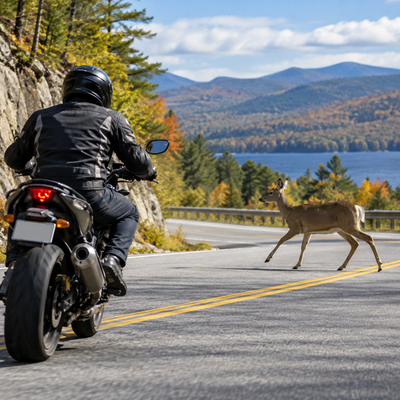
A no-contact motorcycle accident occurs when another driver’s actions cause a motorcyclist to crash even though the other vehicle never physically strikes the motorcycle.
For example, a rider may be traveling through New Hampshire when a car suddenly moves into the motorcycle’s lane. The rider swerves to avoid being sideswiped, reaches the shoulder, and loses control. The vehicles never touch, but the unsafe lane change may still have caused the crash.
No-contact motorcycle accidents can involve situations such as:
- A driver turns left across a motorcycle’s path and forces the rider to brake or swerve.
- A vehicle merges into an occupied lane without leaving enough room for the motorcycle.
- A driver pulls out of a driveway or side street directly in front of a rider.
- A vehicle suddenly changes lanes and forces a motorcyclist off the roadway.
- A driver stops, turns, or changes direction in a way that creates an immediate hazard.
- An unidentified vehicle causes the rider to take evasive action and then leaves the scene.
Motorcyclists have less physical protection than occupants of passenger vehicles. A sudden braking or swerving maneuver can cause severe injuries even when the rider avoids a direct collision.
For more information about motorcycle crashes in New Hampshire, visit:

James J. Tenn, Jr.
Attorney
Mary Elizabeth Tenn
Attorney
John J. Tenn
Attorney
Can Another Driver Be Liable Without Hitting the Motorcycle?
Yes, another driver may be liable even when the vehicles never make contact.
A negligence claim generally focuses on whether a driver failed to use reasonable care and whether that conduct caused the rider’s injuries. Physical contact can provide strong evidence of how a crash occurred, but contact is not the only way to prove causation.
Suppose a motorist begins turning left across a rider’s lane without enough time or distance for the motorcycle to continue safely. The rider brakes hard to avoid the vehicle, the motorcycle goes down, and the rider is injured. Avoiding contact does not necessarily eliminate responsibility for the driver whose actions created the danger.
Questions that may affect liability include:
- What did the other driver do immediately before the crash?
- Did the driver’s conduct violate a traffic law or fall below reasonable driving standards?
- Did the rider have enough time and distance to respond?
- Was the rider’s reaction reasonable under the circumstances?
- Did the other driver’s conduct cause the crash and resulting injuries?
An insurance company may argue that the rider was speeding, following too closely, overreacting, or losing control for another reason. Evidence can become especially valuable when there are no impact marks between the vehicles.
Millions in Verdicts & Settlements
The attorneys at Tenn And Tenn are ready to help you solve your legal problems and obtain results.
$9,000,000
Pedestrian Accident
$2,225,000
Motorcycle Collision
$2,224,000
CarAccident
Why Evidence Matters in a No-Contact Motorcycle Claim
Evidence can be central to a no-contact motorcycle claim because the crash may not leave the same physical signs as a collision between two vehicles.
A traditional crash may leave crushed body panels, paint transfer, vehicle debris, or impact marks. A no-contact motorcycle accident may leave none of those signs.
Useful evidence may include:
- Eyewitness statements
- Traffic camera footage
- Business surveillance footage
- Helmet camera footage
- Dashcam recordings
- Photographs and videos of the scene
- Skid marks and tire marks
- Road gouges or debris
- Motorcycle damage
- Damage to a helmet or riding equipment
- Police observations and reports
- Medical records
- Statements made by the other driver
If another vehicle leaves the scene, details about its make, model, color, license plate, direction of travel, or identifying features may help investigators locate the driver.
Evidence should be preserved as soon as reasonably possible. Surveillance recordings may be overwritten. Roadway marks may disappear. Witnesses may become difficult to locate or may remember fewer details as time passes.
Photographs taken shortly after the crash can help document lane markings, road conditions, sight distances, debris, damage, and the final resting position of the motorcycle.
For motorcycle safety information, visit:
What If the Driver Leaves the Scene?
A no-contact motorcycle crash can become more difficult when the vehicle that caused the crash does not stop.
The rider may not know the driver’s name, insurance company, or complete license plate number. In some cases, uninsured motorist coverage may become a major part of the claim.
RSA 264:15 requires uninsured or hit-and-run motor vehicle coverage in qualifying New Hampshire motor vehicle policies, subject to the statute and the terms of the policy. Coverage questions can depend on the policy, the insured vehicles, the people covered, the circumstances of the crash, and other facts.
New Hampshire has also addressed no-contact hit-and-run claims directly. In Soule v. Stuyvesant Insurance Co., 116 N.H. 595 (1976), a motorcyclist alleged that an unknown vehicle turned into his path, forcing him to swerve and fall. The vehicles did not touch. The New Hampshire Supreme Court concluded that the governing uninsured motorist statute extended coverage to accidents caused by uninsured or hit-and-run motorists without requiring physical contact.
That decision does not mean every no-contact crash automatically qualifies for uninsured motorist benefits. The facts, policy language, available evidence, notice requirements, and current law still need to be reviewed.
A missing driver does not automatically mean a missing claim. Evidence and insurance coverage may still provide a path forward.
Can You Recover If You Were Partly at Fault?
New Hampshire uses a modified comparative fault rule.
Under RSA 507:7-d, an injured person may recover damages if that person’s fault is not greater than the fault of the defendant, or the combined fault of multiple defendants when recovery is allowed against more than one defendant. The damages awarded are reduced according to the percentage of fault attributed to the injured person.
This rule can have a major effect on a no-contact motorcycle claim.
An insurer may argue that the rider:
- Was traveling too fast for the conditions
- Followed another vehicle too closely
- Failed to maintain proper control
- Reacted too aggressively
- Could have avoided the crash another way
Those arguments need to be measured against the evidence.
A rider confronted with a vehicle suddenly entering the lane may have only seconds to choose whether to brake, swerve, or leave the roadway. An investigation may help establish vehicle positions, stopping distance, visibility, roadway geometry, and the amount of reaction time available.
The issue is not whether someone can imagine a different response after the crash. The issue is whether the rider acted reasonably under the circumstances that existed at the time.
What Compensation May Be Available?
A rider injured in a no-contact motorcycle accident may experience many of the same losses as a rider injured in a direct collision.
Depending on the facts and applicable law, recoverable damages may include compensation for:
- Emergency medical treatment
- Hospital care
- Surgery
- Rehabilitation
- Future medical expenses
- Lost wages
- Reduced earning capacity
- Motorcycle repair or replacement
- Damaged riding equipment
- Pain and suffering
- Other legally recognized losses
Motorcycle crashes can cause fractures, head injuries, shoulder injuries, spinal injuries, road rash, knee injuries, and other serious harm.
The value of a claim depends on the individual facts, including the severity of the injuries, medical prognosis, fault, available insurance coverage, lost income, future treatment needs, property damage, and the effect of the injuries on the rider’s daily life.
What Should You Do After a No-Contact Motorcycle Crash?
Your medical needs should come first. Seek emergency care when needed and report symptoms that develop after the crash.
When circumstances allow, report the accident to law enforcement and provide as much identifying information as possible about the vehicle that created the hazard.
Try to document:
- The roadway and lane configuration
- The location where evasive action began
- Skid marks or tire marks
- Damage to the motorcycle
- Damage to your helmet or protective clothing
- Nearby cameras or businesses
- Witness names and contact information
- The other vehicle’s make, model, color, plate information, and direction of travel
Keep copies of medical bills, repair estimates, photographs, insurance correspondence, wage records, and documents showing time missed from work.
You should also notify the appropriate insurance company promptly. Be careful when giving detailed recorded statements in a disputed claim. An insurer may compare an early description of the crash with later evidence when evaluating fault or causation.
For more information about steps to take after a New Hampshire motor vehicle accident, visit:
How Long Do You Have to Bring a Claim?
New Hampshire generally applies a three-year limitations period to many personal actions under RSA 508:4. The statute provides that, unless another law applies, personal actions generally must be brought within three years of the act or omission complained of. A discovery rule may apply when the injury and its causal relationship could not reasonably have been discovered at the time of the act or omission.
The correct deadline depends on the facts and the type of claim. Different rules may apply in cases involving government entities, minors, particular insurance issues, or other special circumstances.
Waiting can create evidence problems even when the filing deadline has not expired.
Video may be erased. Witnesses may become unavailable. Road conditions may change. Vehicles may be repaired, sold, or destroyed. Memories may become less precise.
Preserving evidence early can make a substantial difference if fault or insurance coverage later becomes disputed.
Why No-Contact Motorcycle Claims Can Be Challenging
The main challenge in many no-contact motorcycle claims is proving exactly what caused the rider to crash.
When two vehicles collide, physical damage may confirm that an interaction occurred. In a no-contact crash, an insurer may question whether another vehicle caused the accident at all.
A clear sequence of events can help establish causation:
- Another driver created an immediate hazard.
- The rider reacted to avoid the hazard.
- The evasive action led directly to the motorcycle crash.
- The crash caused the rider’s injuries and losses.
Medical documentation can also help establish when injuries appeared and how serious they were. Consistent descriptions given to police, medical providers, and insurers may help support the rider’s account.
New Hampshire riders can find more related information here:
Speak With a New Hampshire Motorcycle Accident Attorney
A motorcycle does not have to collide with another vehicle for another driver’s negligence to cause a serious crash. If a driver forced you to brake, swerve, leave the roadway, or take another evasive action, the circumstances may support an injury claim, an insurance claim, or both.
Tenn And Tenn, PA represents injured people throughout New Hampshire. The firm’s attorneys can review the crash, available evidence, insurance coverage, comparative fault issues, and potential sources of compensation.
A no-contact motorcycle accident can involve disputed facts and insurance questions. Early legal review can help identify evidence, preserve available information, and clarify your options under New Hampshire law.
This article is for informational purposes only and is not legal advice. Consult an attorney about your specific situation.


 |

 |